We’ve completed phase one of work to install a renewable heat system at the Michelin Scotland Innovation Parc in Dundee – an ambitious joint venture between Michelin, Dundee City Council, and Scottish Enterprise, created to generate economic growth in Scotland and support a fair and just transition to a net zero economy.
With a 32-hectare site and excellent physical connectivity, MSIP offers a dynamic space for all sizes of businesses to locate. As well as large, flexible space, tenants will have access to an innovation campus, a skills academy, business, innovation and skills support, and competitive, green energy delivered from sustainable sources.
Main contractor, Robertson, and the environmental design consultant, Atelier Ten, devised a proposal to utilise steam and power from the adjacent energy from waste (EfW) plant to heat a number of buildings across the 70-acre facility.
James Ramsay was contracted to plan, design and install the steam pipework for the heating stations and routing of condensate pipework to a collection system returning condensate to the EfW plant for reuse as a boiler water feed.
Superheated steam from bleed 1 of the EfW plant steam turbine generator is imported to the MSIP site to meet the heat load requirements of the various buildings’ heating stations (supplied by ATEN) located on site.
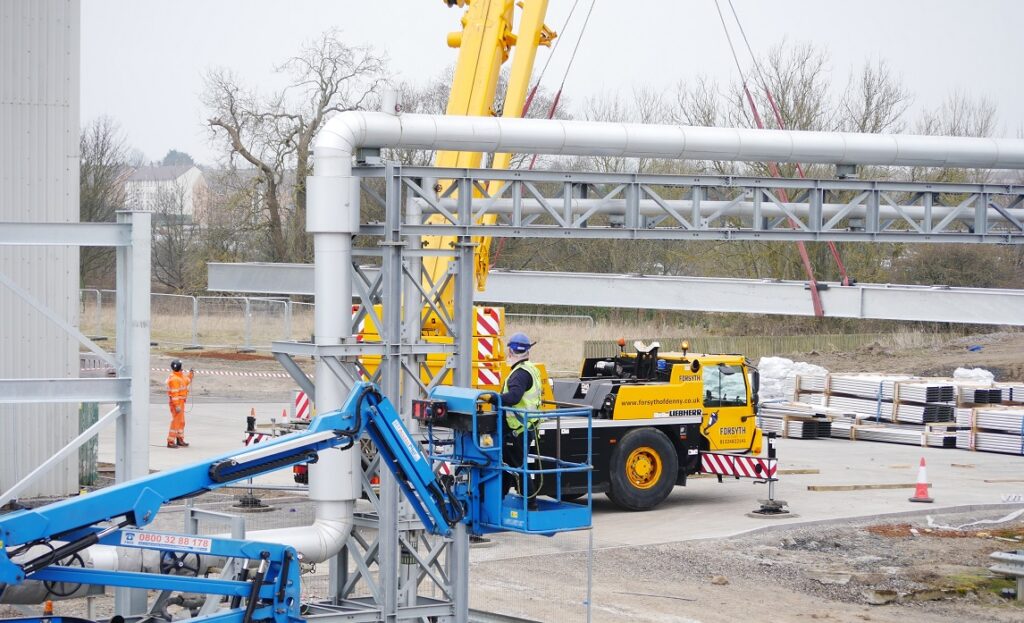
The existing steam infrastructure was extensively modified with redundant supply headers and lines to individual users destructed, and steam now being distributed throughout the site via a new steam header and discrete pipework all designed and installed by James Ramsay.
Gary Shepherd, Managing Director at James Ramsay, said: “This flagship project was both technically and logistically challenging, and demanded the highest standards of quality and safety compliance – so perfectly showcased the skills of our team.
“We devised a design to fit this new idea into an existing building, accommodating numerous constraints such as routes and existing support structures, so we had to be able to think on our feet and adapt designs pro-actively. All these challenges along the way were fully assessed, discussed, passed for technical approval and then delivered whilst maintaining the highest standards of quality.”
James Ramsay was responsible for the planning, design and installation of all mechanical works, providing all the plant and equipment, and assisting with the steam raising and commissioning.
The team also took on the design and installation of the secondary steel supports, a new pipe bridge and the final insulation of the services. All work was carried out in accordance with PSSR Scotland and all welding and testing documentation was produced and approved to the highest of industry standard to satisfy site’s insurance policy.